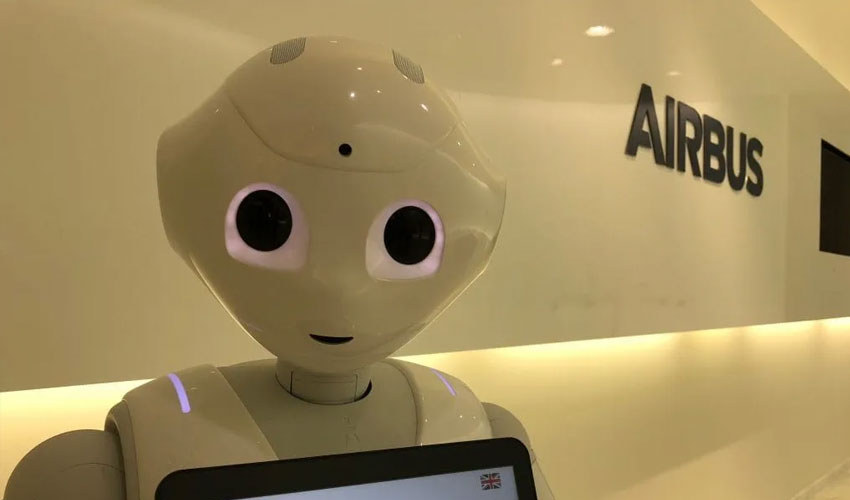
The use of humanoid robots in aircraft manufacturing may soon become a reality as European aerospace giant Airbus explores integrating advanced robots on its assembly lines through a partnership with Chinese robotics firm UBTech.
According to a Bloomberg report, Airbus has signed a deal with Shenzhen-based UBTech to assess how its humanoid robot, the Walker S2, could support human workers in aircraft assembly. While full deployment details remain under evaluation, the move highlights Airbus’s interest in next-generation automation beyond traditional industrial robots.
What is Walker S2?
Unveiled in 2024, the Walker S2 stands 176 centimeters tall and features AI-powered voice interaction via built-in microphones and speakers. Its hands boast 11 degrees of freedom, allowing precise and flexible movements, while the robot can autonomously replace its battery for continuous operation.
Why Airbus is Interested
Unlike conventional robots, humanoid machines can adapt to multiple tasks with minimal reprogramming and operate within existing workspaces without costly infrastructure changes. This versatility makes them attractive for complex production lines requiring precision and adaptability.
Testing Readiness for Industry
Despite rapid technological advances, questions remain about how humanoid robots will perform in high-stakes industrial settings, where safety standards and workflow complexity are paramount. Airbus’s partnership with UBTech indicates confidence that the Walker S2 could complement human expertise on the factory floor.
UBTech’s Global Expansion
Founded in 2012, UBTech reported around $200 million in orders last year and plans to produce up to 10,000 Walker S2 units in 2026. The Airbus collaboration follows a recent deal with US semiconductor company Texas Instruments, signaling UBTech’s growing international presence in the competitive robotics market.
Airbus has been approached for further details regarding the deployment of the Walker S2 in its factories, with more information expected as trials advance. Successful integration could redefine aircraft assembly, blending human skill with humanoid robotics.