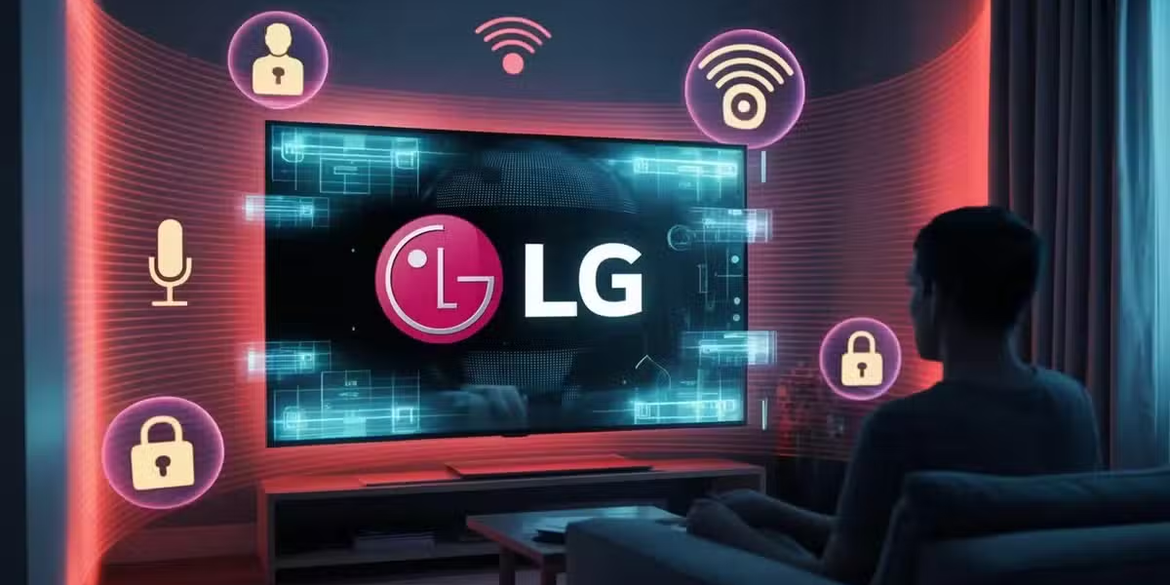
LG has rejected allegations that its smart televisions continuously record private conversations or secretly upload ambient audio, following a recent investigation that raised questions about the company’s privacy practices.
The claims emerged after YouTube channel Gamers Nexus worked with security researchers to examine LG smart TVs. The investigation used methods including network packet captures and analysis of the televisions’ firmware.
The researchers raised several concerns about how LG smart TVs may collect and process information, including when certain devices are offline or operating in standby mode.
One of the concerns involved the collection and storage of information while a television was not actively connected to the internet. Researchers claimed that some data could continue to be gathered locally even when the TV was offline.
The investigation also examined how LG televisions interact with other devices and networks in their surroundings. Researchers reportedly found that the TVs could scan devices connected to the same local network and collect information about nearby Wi-Fi networks.
Another major concern involved the microphones built into certain smart TV models. The investigation raised questions about whether ambient audio could be captured and stored by the television.
Researchers further claimed that audio potentially collected while a TV was disconnected from the internet could remain stored locally and later be uploaded once the television regained an online connection.
Such a scenario has raised obvious privacy concerns because smart TVs are commonly located in living rooms and other areas where people regularly hold private conversations.
However, LG has pushed back against the characterization that its televisions are secretly recording users continuously. The company’s response comes as consumers and technology researchers increasingly examine the amount of information collected by connected household devices.
The investigation also focused on Automatic Content Recognition, commonly known as ACR. The technology is designed to identify content displayed on a television and can be used to provide features such as content recommendations and viewing-related services.
ACR has become a significant privacy issue across the smart TV industry because the technology can involve the collection of information about what users watch.
For manufacturers, such systems can help personalize television experiences and support advertising or recommendation features. For consumers, however, the practice raises questions about what information is collected, how long it is retained and where it is sent.
The LG investigation highlights the wider privacy challenges associated with smart home devices. Modern televisions are no longer simply screens for watching broadcast channels or streaming services. They can include microphones, cameras or sensors, internet connectivity and software capable of interacting with other devices.
This connectivity can provide useful features but also creates additional privacy considerations for users.
LG’s rejection of the allegations is therefore likely to draw further attention to the company’s explanations of how audio collection, network scanning and ACR features operate on its smart TV platform.
For consumers, the controversy also emphasizes the importance of reviewing privacy settings before enabling smart features. Users should understand which data-collection options are active and whether features such as content recognition or voice functionality can be disabled.
The investigation does not necessarily mean that every LG smart TV is continuously recording conversations or secretly uploading audio. The specific capabilities and settings can vary between television models, software versions and enabled services.
As smart TVs become increasingly integrated with artificial intelligence and connected-home ecosystems, questions about privacy and data collection are likely to become even more important.
The dispute between the researchers’ findings and LG’s response ultimately reflects a broader challenge for the technology industry: balancing advanced smart features with clear privacy protections and transparent communication about how consumer data is handled.

