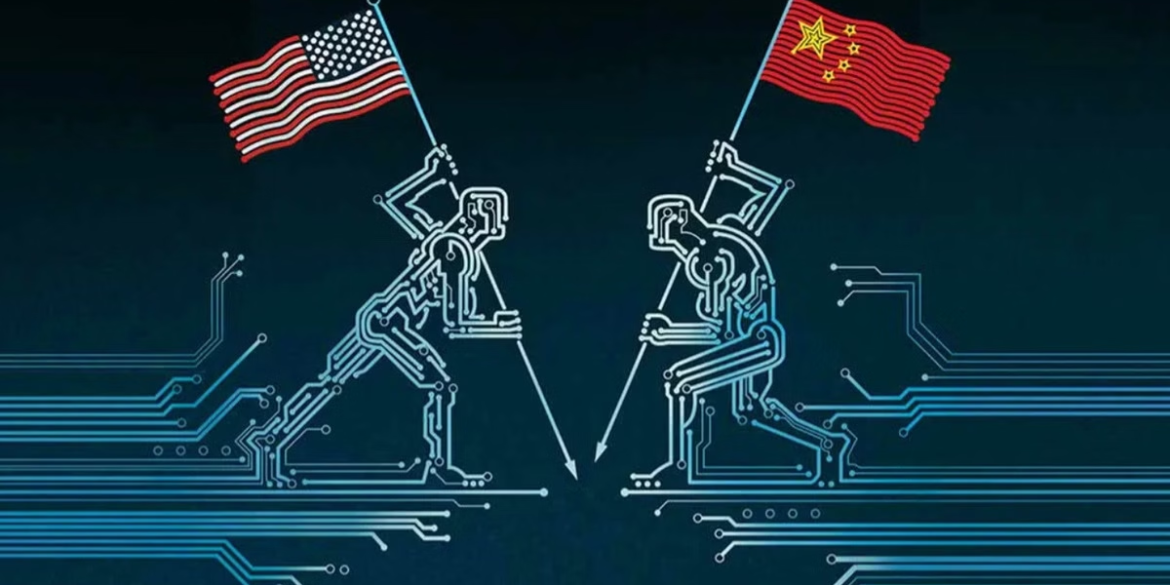
The United States has warned that Chinese artificial intelligence companies could face sanctions over allegations of intellectual property misuse, increasing tensions between Washington and Beijing in the rapidly growing global AI industry.
US Treasury Secretary Scott Bessent renewed his warning on Wednesday, stating that the United States may take action against Chinese AI firms accused of violating intellectual property rights. His comments came amid growing concerns in Washington over the use of American-developed AI technologies by foreign competitors.
The statement followed an accusation from a White House official that China-based AI company Moonshot had allegedly used Anthropic’s Fable model to train its own artificial intelligence system through a process known as model distillation.
Model distillation is a widely used AI training technique in which a smaller model learns from the outputs generated by a larger and more advanced model. The method allows developers to create more efficient AI systems that require fewer computing resources while maintaining useful capabilities.
However, authorities and technology companies have raised concerns that model distillation can become problematic if it involves unauthorized access to proprietary models, confidential data, or protected intellectual property. While some cases may violate ownership rights, the technique itself is also considered a legitimate and common practice in AI development.
Bessent emphasized the US position on protecting American innovation, writing on social media platform X that “open source is not open season on American IP.” His remarks highlighted Washington’s broader concerns about safeguarding US technological advantages in artificial intelligence.
The allegations involving Moonshot and Anthropic have added another layer to ongoing competition between American and Chinese technology companies. Both countries are investing heavily in AI research, advanced computing infrastructure, and large language models as they seek leadership in a strategically important industry.
The possibility of sanctions reflects the US government’s broader approach toward restricting access to advanced technologies that it considers important for national security and economic competitiveness. In recent years, Washington has introduced various measures affecting semiconductor exports, AI-related technologies, and high-performance computing capabilities.
Chinese AI companies, meanwhile, have continued expanding their research and development efforts despite increasing restrictions. Several firms are working to develop domestic AI models and reduce dependence on foreign technology through local innovation and alternative supply chains.
The debate over AI model distillation also highlights broader questions about intellectual property protection in the artificial intelligence sector. As AI models become more advanced, companies and regulators are increasingly examining how training methods, data usage, and technology sharing should be managed.
Industry experts say balancing innovation with intellectual property protection will be one of the biggest challenges facing the global AI ecosystem. While companies rely on techniques such as distillation to improve efficiency and accessibility, governments are seeking stronger safeguards to protect technological investments.
The latest warning from the US Treasury adds to the growing competition between the world’s two largest economies over artificial intelligence leadership. Any future sanctions or regulatory actions could have wider implications for international AI development, technology partnerships, and the global digital economy.